
The Tao of Art & Censorship
Climax
The Tao of Art & Censorship: a Very Short Version
Thoughts by Savannah Spirit
Art and censorship have a long, long history together. They tend to be enemies; the kind that feed off of each other. “You’ve been censored,” are three words an artist loathes to hear. Those words can kill the spirit of the artist’s intention. People or groups censor artists because artists, by nature, speak the truth, probe, question, and present ideas. Some people take offense to the truth (Whether it’s someone else’s truth or their own). Censorship used to mean adhering to an ancient set of morals, regarded by the ancient Greeks of Rome as an honorable thing to do for the good of the people. That was a long time ago. Censorship is now the opposite. It now represents fear. Fear that the artwork in question will challenge the viewers so much it may offend them; fear of what others may think or fear of their own demons. Socrates, sentenced to drink poison for “corruption of youth” in 399 BC, all the way to last year’s arrest of Pussy Riot for staging a performance at Moscow’s Cathedral of Christ the Savior. Many artists, free thinkers, and writers have found their work banned or censored. This constant tumultuous relationship between art and censorship is like oil and water.
Or is it? From my own personal experience of being censored on Facebook, I found there is an entirely different way of looking at this issue—art and censorship can also be like milk and honey. Censorship of anything that comes out of someone’s heart, sweat, soul, and tears is one of the worst feelings. When someone or a group decides that your art shouldn’t be shown or even altered just a little bit, it’s because of fear. Sometimes censorship backfires and can bring attention to the artist and the artwork if all the stars are aligned.
Photographer Andres Serrano lost grants and had death threats due to “Piss Christ,” but his nemesis, Jesse Helms did him a much bigger favor. Serrano rose to celebrity status simply because Senator Helms denounced it. He may even tell you himself that it helped his career in the long run, not hindered it. That was 1989 and as a teen I was nowhere near the flames of censorship, let alone heard of Andres Serrano. However, it happened to me not
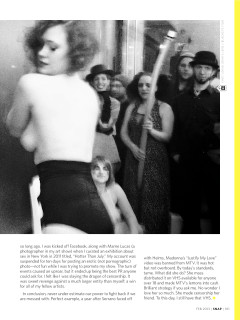
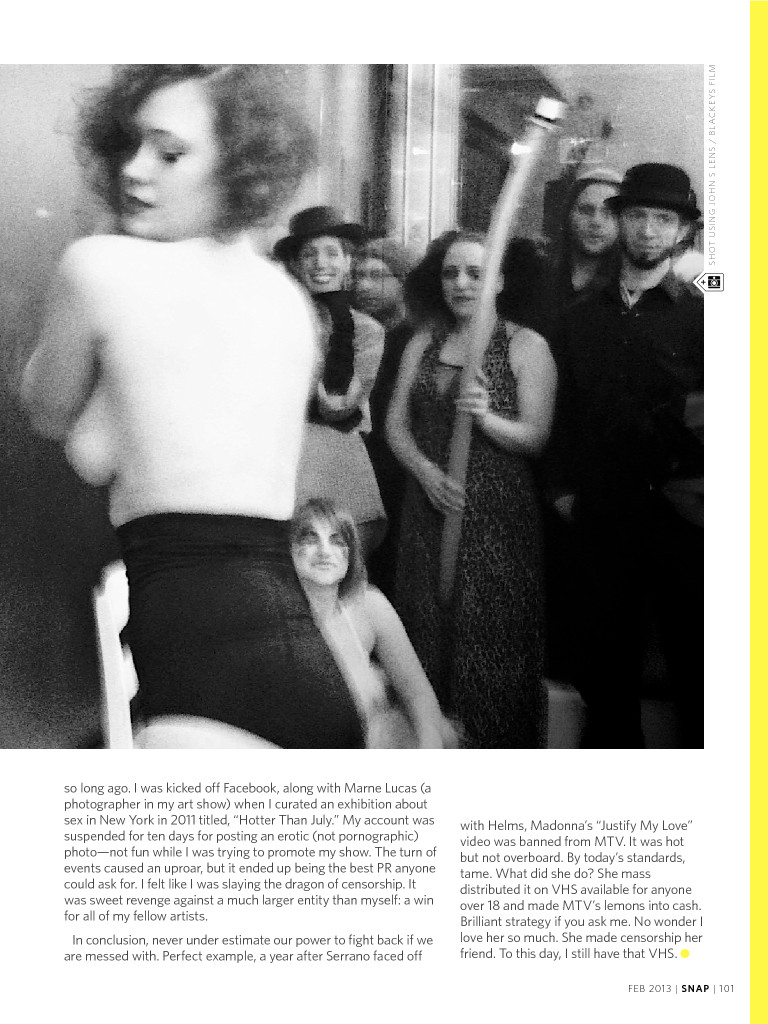
so long ago. I was kicked off Facebook, along with Marne Lucas (a photographer in my art show) when I curated an exhibition about sex in New York in 2011 titled, “Hotter Than July.” My account was suspended for ten days for posting an erotic (not pornographic) photo—not fun while I was trying to promote my show. The turn of events caused an uproar, but it ended up being the best PR anyone could ask for. I felt like I was slaying the dragon of censorship. It was sweet revenge against a much larger entity than myself: a win for all of my fellow artists.
In conclusion, never under estimate our power to fight back if we are messed with. Perfect example, a year after Serrano faced off with Helms, Madonna’s “Justify My Love”
video was banned from MTV. It was hot but not overboard. By today’s standards, tame. What did she do? She mass distributed it on VHS available for anyone over 18 and made mtv’s lemons into cash. Brilliant strategy if you ask me. No wonder I love her so much. She made censorship her friend. To this day, I still have that VHS.