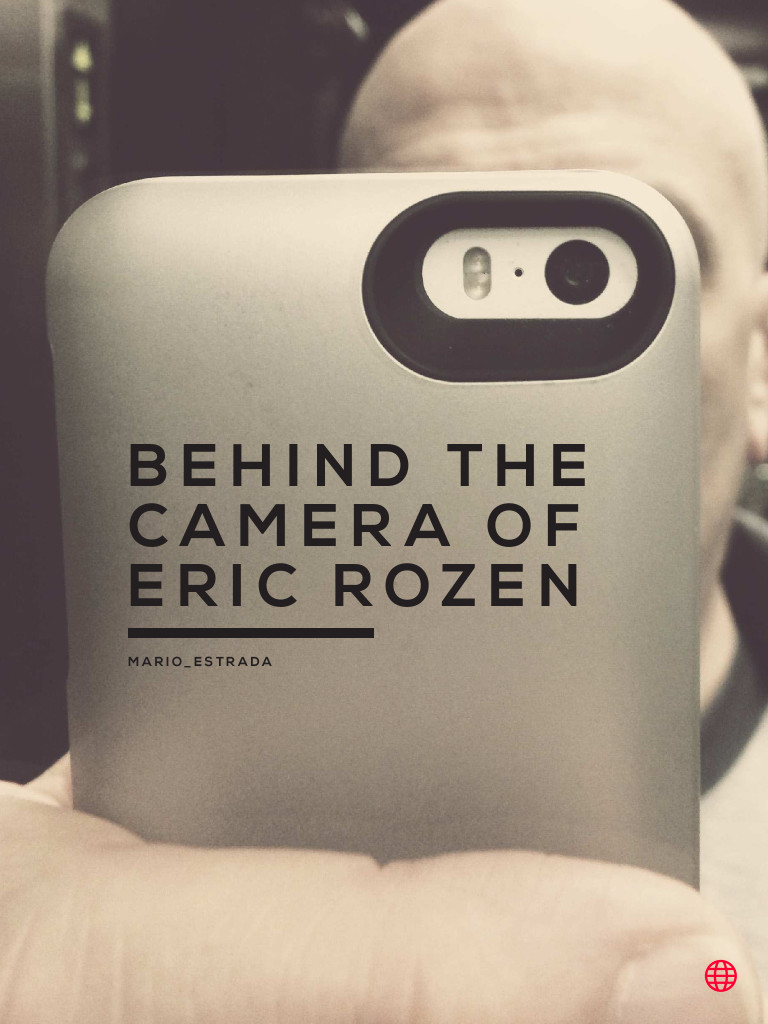
Behind the Camera of Eric Rozen
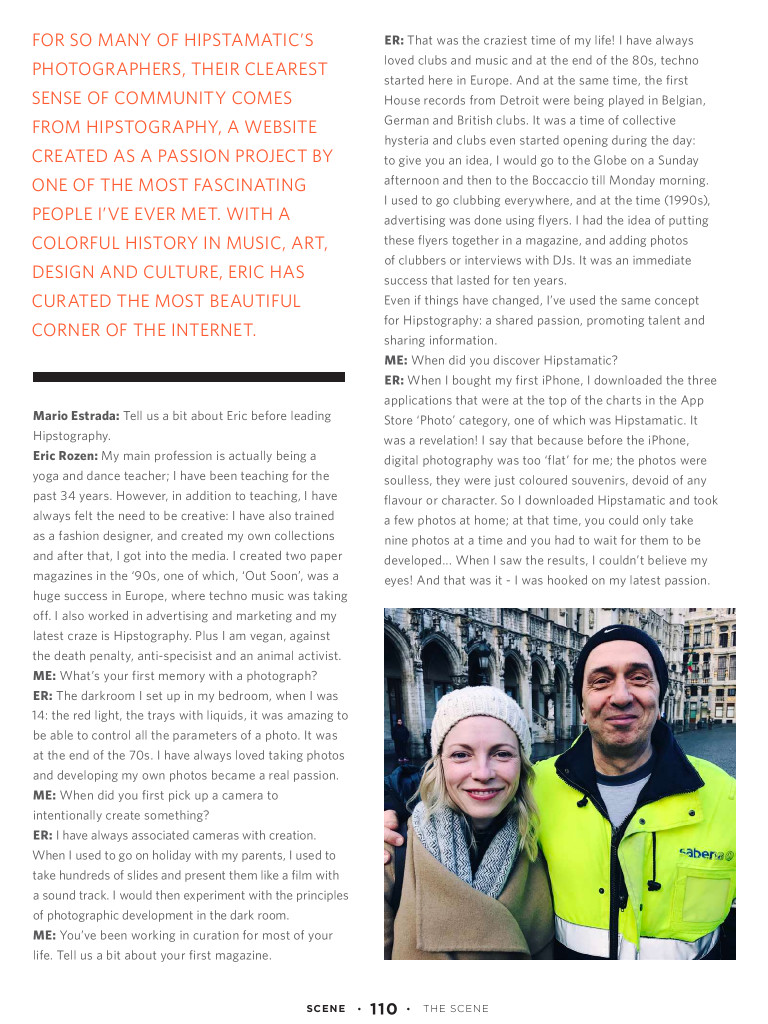
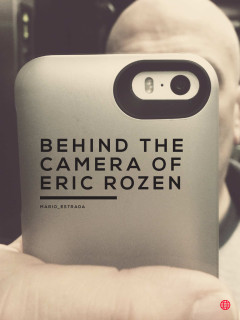
For so many of hipstamatic’s photographers, their clearest sense of community comes from Hipstography, a website created as a passion project by one of the most fascinating people I’ve ever met. With a colorful history in music, art, design and culture, Eric has curated the most beautiful corner of the internet.
Er: That was the craziest time of my life! I have always loved clubs and music and at the end of the 80s, techno started here in Europe. And at the same time, the first House records from Detroit were being played in Belgian, German and British clubs. It was a time of collective hysteria and clubs even started opening during the day: to give you an idea, I would go to the Globe on a Sunday afternoon and then to the Boccaccio till Monday morning. I used to go clubbing everywhere, and at the time (1990s), advertising was done using flyers. I had the idea of putting these flyers together in a magazine, and adding photos of clubbers or interviews with DJs. It was an immediate success that lasted for ten years.
Even if things have changed, I’ve used the same concept for Hipstography: a shared passion, promoting talent and sharing information.
me: When did you discover Hipstamatic? Er: When I bought my first iPhone, I downloaded the three applications that were at the top of the charts in the App Store ‘Photo’ category, one of which was Hipstamatic. It was a revelation! I say that because before the iPhone, digital photography was too ‘flat’ for me; the photos were soulless, they were just coloured souvenirs, devoid of any flavour or character. So I downloaded Hipstamatic and took a few photos at home; at that time, you could only take nine photos at a time and you had to wait for them to be developed... When I saw the results, I couldn’t believe my eyes! And that was it - I was hooked on my latest passion.
Mario Estrada: Tell us a bit about Eric before leading Hipstography.
Eric Rozen: My main profession is actually being a yoga and dance teacher; I have been teaching for the past 34 years. However, in addition to teaching, I have always felt the need to be creative: I have also trained as a fashion designer, and created my own collections and after that, I got into the media. I created two paper magazines in the ‘90s, one of which, ‘Out Soon’, was a huge success in Europe, where techno music was taking off. I also worked in advertising and marketing and my latest craze is Hipstography. Plus I am vegan, against the death penalty, anti-specisist and an animal activist. me: What’s your first memory with a photograph? Er: The darkroom I set up in my bedroom, when I was 14: the red light, the trays with liquids, it was amazing to be able to control all the parameters of a photo. It was at the end of the 70s. I have always loved taking photos and developing my own photos became a real passion. me: When did you first pick up a camera to intentionally create something?
Er: I have always associated cameras with creation. When I used to go on holiday with my parents, I used to take hundreds of slides and present them like a film with a sound track. I would then experiment with the principles of photographic development in the dark room.
me: You’ve been working in curation for most of your life. Tell us a bit about your first magazine.
me: There were other communities, what was the moment you decided a central hub was necessary? Er: There were communities but they didn’t communicate much between themselves. When I saw a great photo on the internet that had been taken with Hipstamatic, I used to contact the photographer to ask them what combo they had used. That often led to us getting into a discussion... and I came to realized that I was not the only person to be fascinated by this little app and the idea of launching a website came about pretty fast. Unlike my first magazine, Out Soon, where I had to collect tens of thousands of euros each month through advertising major brands to fund the magazine (50 000 copies in two languages, printed in colour, distributed in several countries, but also with a team including journalists, graphic designers, etc....), I told myself that I would do Hipstography for fun, for my own pleasure, without any financial constraints. I pay for all the costs myself, and even if it is hard work, I continue to adore Hipstamatic.
me: Tell us a bit about the Hipstography awards, and getting top talent as both artists and judges.
Er: I think that we are living in a world that goes too fast: a photo published on Instagram or Facebook is forgotten the next day or drowned out in a continuous stream of photos. The Hipstography awards are first and foremost an opportunity to look again at series that were published over the previous twelve months, whether or not they were awarded a prize. There are so many beautiful photos or series that really deserve our attention. I find it really amazing that an app like Hipstamatic can allow hundreds of thousands of people to express themselves in images.
As regards the judges, I must say that I am really honoured and delighted to have such a panel to assess the photos. When I send an email to someone like Dan Mindel to ask whether he would be prepared to be on the jury and he replies immediately “with pleasure”, I must admit that makes me extremely happy. And I feel the same way about him or any other member of the jury. Furthermore, I have been lucky enough to receive their comments on certain artists or series, and I have been really touched that they have cared enough to devote their time and attention.
me: Has Mobile changed your definition of a photograph? Er: Once again, I can see overlaps between my magazine on techno music and Hipstography: at the end of the 80s, the major record companies and mainstream media said that techno or house music wasn’t “real” music. They did not appreciate the fact that to make a hit song, it was no longer necessary to spend millions and sign contracts; it was enough to have a few synthesisers at home and a mixing console. And a few ideas of course. It took years for mentalities to change.
with mobile phones, it’s the same thing: according to some media opinions, especially in Europe, it isn’t “real” photography. Apple has democratised photography and apps like Hipstamatic are powerful tools that enable people to express their creativity.
in Hipstography’s first year, I published an interview with Richard Koci that really sums up what mobile photography is; he said, among other things: “It doesn’t matter to me how much blood, sweat and tears it took to create your image — whether it was hours in Photoshop, or a simple touch on a smartphone screen to convert your image to black-and-white. I don’t think that the process detracts from the art of photography. Photography is about photography — the images, not the process.”
Click to read the Richard Koci Interview.
Visit Hipstography.com
me: You look at a lot of photos, In the last year, what’s the biggest trend you’ve noticed in the way people take/share photos?
Er: We are starting to see improvements in photo quality. A few years ago, people would take photos of anything and everything: their feet, a cup of coffee, a building... Now, some people manage to create their own universe and I find that fascinating. I love coming across a series of photos that tells a story, that makes you feel what the photographer wanted to express... It is rare, but what a joy when it does happen!
me: What’s your trend forecast for 2018? Er: I think and hope that street photography will develop further; this is a very challenging medium and it is not enough to just take few shots while strolling through town. Not many photographers manage to overcome the inherent difficulties, but when they do, what a delight it is! Plus the quality of mobile phones is ever improving - you just have to think back to the quality of the first iphones for those of us who can remember! The photos were in pixels and almost impossible to print. The fact that photography is so important for Apple, who never stop innovating, makes me say that the future looks bright and will be interesting!
me: Anything you want to add ? Er: Thanks to Hipstamatic for all the pleasure they have given me over the years... I am planning to collaborate with various Facebook groups and I really enjoy this process.